Tuesday Tip

When a resident is away from their unit for an extended period, the reason matters.
A long stay in a rehabilitation facility is different from an indefinite stay at a second home. Likewise, military deployment may require different considerations than a vacation. Therefore, owners and agents need to understand the circumstances before deciding what comes next.
This Tuesday Tip looks at extended tenant absences, the importance of documentation, and why a clear written policy can help property teams handle these situations consistently
Start With the Reason for the Absence
First, review HUD guidance and your property’s policies on extended absences.
Then, determine why the resident is away. For example, the resident may be in a hospital, rehabilitation center, or skilled nursing facility. A medical issue may also require someone to temporarily stay with family. On the other hand, a resident may simply be traveling or staying at another home.
The circumstances can affect how management responds.
In particular, consider whether the situation may involve a reasonable accommodation or an exception under your policy. If it does not, the extended absence may need to be addressed under the property’s applicable lease or house rules.
Is There a Reasonable Expectation of Return?
One of the most important questions is whether there is a reasonable expectation that the resident will return to the unit.
This can become especially important when a resident enters a rehabilitation center or skilled nursing facility for an extended stay.
For example, a resident recovering from a car accident may expect to spend three months in rehabilitation before returning home. Documentation supporting that expected stay and return can help management evaluate the situation.
However, a resident who has moved to a second home indefinitely but says they might return presents a different situation.
Owners and agents should review the available documentation and the individual circumstances rather than making assumptions.
Document the Absence
Documentation is an important part of managing extended tenant absences.
Depending on the circumstances, documentation might include a letter from a healthcare facility or medical provider. It could also include a signed statement from the resident or the resident’s legal representative.
The goal is to document relevant information about the absence and whether the resident is expected to return.
However, be careful when requesting medical information. Property staff should not unnecessarily ask for a resident’s diagnosis, level of care, or other medical details simply to investigate an absence.
Instead, focus on the information needed to evaluate the situation and follow applicable Fair Housing requirements.
Put Your Policy in Writing
If your property does not already have a written extended absence policy, now is a good time to review whether one is needed.
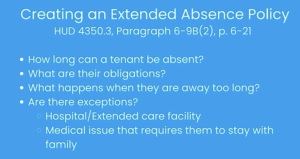
HUD Handbook 4350.3, paragraph 6-9(B)(2), provides guidance owners and agents can review when developing their policies.
A written policy should address questions such as:
- How long can a resident be away before the absence becomes an issue?
- What responsibilities does the resident have while away?
- What happens when an absence exceeds the property’s established limit?
- What exceptions may apply for hospital stays, extended-care facilities, medical circumstances, or other qualifying situations?
In addition, consider communicating the policy before an extended absence occurs. For example, you may include it in house rules or other materials provided at move-in.
That proactive approach can help residents understand their responsibilities and reduce confusion later.
Some Extended Absences Need Special Consideration
Not every extended absence fits neatly into the same process.
For example, HUD separately addresses permanently confined family members. When a family member permanently resides in a nursing home or similar facility, owners and agents may need to consider how that person is treated as a household member, how income and expenses are handled, and how required documents will be signed.
Military deployment also has specific considerations. HUD Handbook 4350.3, paragraph 5-6(C), addresses situations involving family members on active military duty.
Among other considerations, the guidance discusses reasonable flexibility with rent arrangements, caregivers for minors remaining in the unit, and arrangements for required certifications and signatures.
Because these situations can affect several areas of property operations, owners and agents should review the applicable HUD guidance rather than treating every extended absence the same way.
Frequently Asked Questions About Extended Tenant Absences
What is considered an extended tenant absence?
Properties should review HUD guidance and their own written policies to determine how extended absences are addressed. A written policy can establish how long residents may be away, their responsibilities during an absence, and any applicable exceptions.
How should owners document an extended tenant absence?
Documentation should support the circumstances of the absence and whether the resident is expected to return. Depending on the situation, that may include information from a healthcare facility or provider or a signed statement from the resident or legal representative.
Can a medical absence involve a reasonable accommodation?
Potentially. Owners and agents should consider whether the circumstances may qualify for a reasonable accommodation or an exception to the property’s policy. They should also avoid requesting unnecessary medical information.
What should an extended absence policy include?
A policy should explain how long residents may be away, their responsibilities while absent, what happens when an absence exceeds the established limit, and what exceptions may apply. HUD Handbook 4350.3, paragraph 6-9(B)(2), is identified in this week’s Tuesday Tip as guidance to review when developing a policy.