How to reduce repeat findings and recurring errors
Program integrity practices reduce repeat issues through standard work, clear documentation, and targeted quality checks.

Program integrity practices reduce repeat issues and keep expectations clear and consistent. Affordable Housing Month is a good time to shine a light on that behind-the-scenes work.
Program integrity often gets noticed only when something goes wrong. However, repeat issues usually point to a system problem, not a character problem. Most recurring errors come from unclear expectations, uneven training, or missing verification.
Three levers tend to move the needle: standard work, quality checks, and feedback loops. None of those tools is complicated. Consistency is what makes them effective.
A strong integrity system doesn’t punish mistakes. Instead, think about it this way: better systems reduce the conditions that produce mistakes in the first place.
Why repeat issues happen
Bad actors aren’t the usual cause. Variation is. One staff member processes a task one way, another does it differently. Site teams interpret the same rule in different ways. Supervisors accept varying levels of documentation, which causes issues.
Pressure also plays a role. Shortcuts can feel efficient in the moment. However, missing documentation becomes expensive later. A correction might be completed, yet proof never makes it into the file. Because of this, the issue shows up again at the next review.
Weak corrective action plans also add fuel. Remember, fixing the symptom isn’t the same as preventing the cause.
The practices that reduce repeats
Standard work sets the floor. A defined process, required documents, and a clear completion standard prevent drift when staffing changes.
Routine quality assurance does more than random spot checks. A small weekly sample catches trends early. Early catches cost less to fix. Faster feedback helps teams adjust before errors spread.
Key Takeaways
- Repeat findings usually signal system gaps, not individual failure.
- Standard work creates consistency across sites and staff turnover.
- Routine QA catches trends early and reduces costly rework.
- Corrective actions work best when verification is built in.
- Training should be driven by patterns, not assumptions.
Root-cause analysis closes the loop. Asking “Why did this happen?” should not feel like an interrogation. Attention belongs on triggers, handoffs, unclear instructions, and missing tools. Naming the root makes improvement possible.
Add to that the fact that corrective actions need measurable parts. A plan should state the fix, the owner, the timeline, and how verification will happen. Proof matters because a system can’t learn without evidence.
Trend-based training keeps improvement real, but training that ignores findings turns into background noise. You want training tied that is tied to patterns. Improved performance is the result.
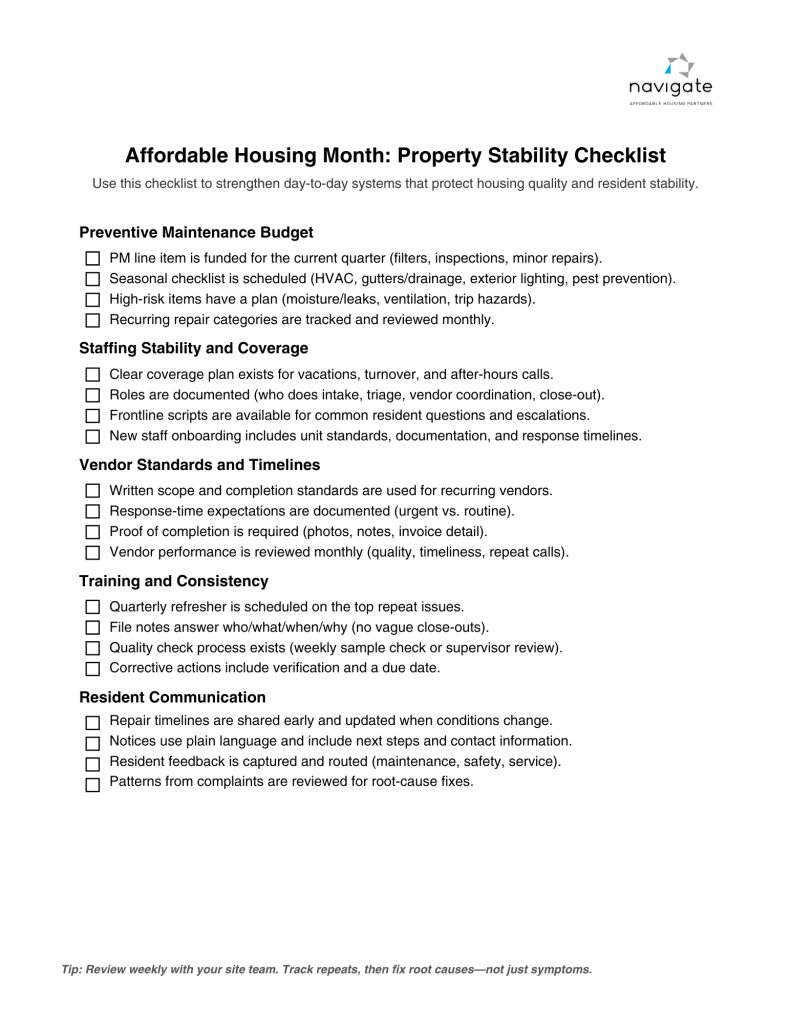
Download: Property Stability Checklist
Print it for your maintenance huddle or supervisor walk. Track repeats, then fix root causes—not just symptoms.
Program integrity practices that stop repeat issues
Checks work best before deadlines create panic. A weekly mini-audit often does the job while monthly trend reviews add clarity. Quarterly refreshers also keep standards from drifting.
A staff can reduce debate with simple verification. A checklist tied to required proof promotes clarity, and visual examples help too. When “good” is clearly defined, teams deliver better work.
Program integrity practices for consistent documentation
As always, clean documentation is the backbone. Any notes you add to a file should answer who, what, when, and why. The files should show the decision path. Also, all proof should be stored the same way every time to ensure oversight stays fair and efficient.
Reduce errors. Build trust.
Repeat issues are not inevitable. Systems can be designed to learn. Standard work, routine QA, and real feedback loops reduce error rates and build trust over time.