HUD just shortened the timeline—again
HUD is giving PHAs and HUD‑funded housing owners 30 days to review the EIV‑SAVE Tenant Match Report and take corrective action.

Edited to clarify EIV-SAVE is only for PIH.
EIV-SAVE
If you read our recent post, SAVE Verification Compliance: PBRA owner and agent actions, you already know the direction HUD is moving: tighter scrutiny, less tolerance for informal practices, and more emphasis on file proof and system accuracy.
Now, HUD has made the expectation explicit—and urgent.
Last Friday (01/23/2026), in HUD News Release HUD No. 26‑008, HUD says a HUD/DHS audit identified several discrepancies. These include:
- nearly 200,000 tenants requiring eligibility verification,
- nearly 25,000 deceased tenants, and
- nearly 6,000 ineligible non‑American tenants.
What HUD flagged in EIV/SAVE matching
Records needing eligibility verification
Records tied to deceased tenants
Records showing possible ineligibility
HUD’s January 2026 Owner/Agent letter: PBRA expectations are not optional
HUD recently sent a letter directed specifically to Multifamily Owners and Agents. It reinforces Section 214 requirements and makes clear that eligibility verification is a file-proof obligation, not just a system step.
For PBRA Owners and Agents, the letter underscores two operational duties:
- Verify citizenship or eligible immigration status before admission and before adding a household member.
- Prorate assistance for mixed-status households when an ineligible noncitizen resides in the unit.
The letter also clarifies what “file-proof” looks like in practice:
- Keep signed declarations and required consent forms.
- Use SAVE as the primary verification method and retain the SAVE results in the tenant file.
- If SAVE cannot confirm status, initiate additional verification promptly and document every step.
- Maintain strong identity controls and keep transmitted data aligned with the file.
Why this matters now: HUD’s 30-day EIV/SAVE push is about discrepancies. The Owner/Agent letter is the standard HUD will use to evaluate whether your PBRA files and transmissions support eligibility determinations.
What HUD says must happen within 30 days
HUD states that PHAs must review their EIV‑SAVE Tenant Match Report, verify that citizenship/immigration status is accurately reported for eligibility, and initiate corrective actions within 30 days. HUD also signals sanctions and funding recapture for payments made on behalf of ineligible and deceased tenants.
The EIV‑SAVE Tenant Matching Report: what it is (and what it isn’t)
HUD’s PHA letter describes the new report, EIV‑SAVE Tenant Matching Report. It cross‑references IMS/PIC data with USCIS SAVE data. It also flags individuals who need confirmation due to potential discrepancies. Importantly, inclusion on the report does not automatically mean someone is ineligible—it often means you need to do more verification/classification work.
HUD instructs agencies to:
- Review the report and confirm correct reporting/coding
- Ensure you complete and document SAVE verification steps
- Retain documentation supporting eligibility determinations
- Initiate corrective actions quickly when the data is wrong
The letter notes that the report appears in EIV as an option within the Income Validation Tool (IVT) Report.
What this means for PBRA Owners & Agents
Even though HUD addressed the letter to PHAs and references HUD‑50058/PIC, HUD’s broader message is that owners participating in HUD‑funded housing are also on the 30‑day clock. For PBRA, the practical focus is the same:
Tenant file determinations and transmitted data must match.
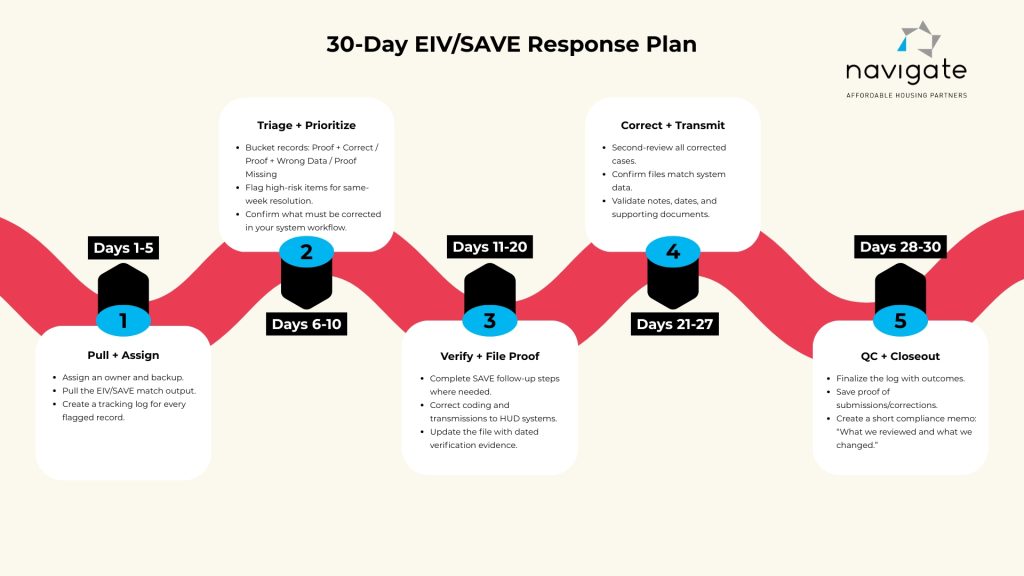
A 30‑day EIV-SAVE action plan (PHAs)
- Assign ownership + calendar the deadline
- Pull the EIV‑SAVE match output and create a tracking log
- Triage flags:
- File proof exists + HUD data is correct
- File proof exists, but HUD data is wrong (prioritize these corrections)
- File proof missing/incomplete (start verification workflow immediately)
- Validate the file (declarations, supporting docs, SAVE results, proration where applicable)
- Correct HUD records (don’t just fix paperwork—fix the transmitted data)
- Document everything (report pulled date, actions taken, corrected submissions, outcomes)
- Reinforce monthly controls (identity/EIV routines that prevent future mismatches)
Bottom line
HUD has linked SAVE verification, EIV reporting, and enforcement—on a short clock. PHAs should use the 30‑day checklist above to turn the directive into an audit‑ready response.