
Many people hear the term PBCA and wonder what it means. Others may see it while searching for Section 8 housing, HUD compliance, or affordable housing resources. So, what is a PBCA?
A PBCA is a Performance-Based Contract Administrator. PBCAs help the U.S. Department of Housing and Urban Development administer certain Project-Based Section 8 contracts. These contracts are tied to specific affordable housing properties. That distinction matters because Project-Based Section 8 is not the same as the Housing Choice Voucher program (HCV). Project-Based Rental Assistance, often called PBRA, is connected to specific properties. Housing Choice Vouchers are connected to eligible households and are administered by local public housing agencies.
For a deeper explanation, read our guide on PBRA vs. Housing Choice Vouchers. Navigate Affordable Housing Partners serves as a HUD PBCA for Project-Based Rental Assistance. That means Navigate’s Section 8 work is on the project-based side, not the voucher side.
What Is a PBCA in Affordable Housing?
PBCAs help HUD oversee Project-Based Section 8 contracts with property owners. HUD contracts with owners to keep certain rental units affordable for eligible families. The PBCA helps administer and monitor many of those contracts, supporting housing stability, promoting compliance, and protecting federal housing resources.
What Is a PBCA Responsible For?
A PBCA supports several parts of Project-Based Section 8 contract administration. These responsibilities serve a dual purpose. They help HUD monitor program performance and help owners and agents understand requirements and maintain compliance.
Contract renewals are a major part of this work. Owners and agents can use Navigate’s contract renewals page to find renewal guidance and related information.
Rent adjustments are another important area. Navigate’s rent adjustment guidance helps owners and agents understand the process and required submissions.
PBCAs also support residents in certain situations. Residents at PBRA properties may have concerns about health, safety, management, or other serious issues. Navigate’s resident concern resources explain how residents can share those concerns when appropriate.
This work is technical, but it has a human purpose. Strong contract administration helps preserve affordable housing and ensure assisted properties continue serving eligible families.
What HUD Does, What PBCAs Do, and What Owners Do
Project-Based Section 8 works best when each role is clear.
HUD sets federal program rules. The agency also provides funding, issues guidance, and oversees the larger PBRA program. That oversight helps keep affordable housing resources connected to national housing goals.
PBCAs help carry out contract administration responsibilities for HUD. They monitor and review many contract-related activities and help ensure owners and agents follow the rules.
Owners and agents manage the property. They work directly with applicants and residents. Their responsibilities include income certifications, recertifications, maintenance, and many resident-facing responsibilities. When owners and agents need forms or guidance, Navigate’s resources page can help. It includes frequently requested materials related to contract administration.
Clear roles also help families know where to go for help.
What Is a PBCA Not Responsible For?
A PBCA is not the same as a public housing agency, so it does not administer Housing Choice Vouchers. This point is important because many people use “Section 8” as a general term. However, Section 8 includes different programs.
Housing Choice Vouchers, often called HCVs, are tenant-based. The eligible family or individual holds the voucher. Local public housing agencies administer those programs. However, PBRA works differently. In PBRA, assistance is tied to the property. Families generally apply through the property or its management office.
Navigate does not issue Housing Choice Vouchers. We do not manage HCV waiting lists. Navigate does not approve voucher portability requests. Families looking for voucher information should read Navigate’s Housing Choice Voucher program explainer. That page explains the difference and points families toward the correct local resources.
This distinction also helps protect families from scams. Fake websites may use the phrase “Section 8” to collect fees or personal information. Navigate’s Section 8 scam alert explains common red flags and reminds families that Navigate does not charge application fees. Before applying online, families should verify the source. They should also confirm whether they are applying for a property-based unit or a Housing Choice Voucher.
What Is a PBCA in Relation to PBRA and Vouchers?
The easiest way to understand the difference is to look at where the assistance sits.
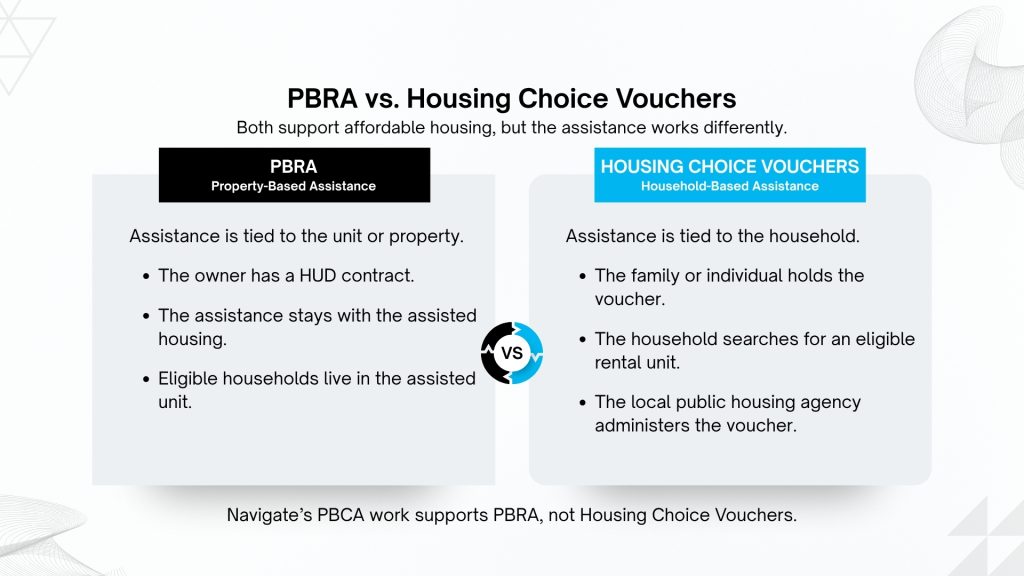
So, what is a PBCA in this structure? A PBCA supports HUD’s oversight of Project-Based Section 8 contracts. A PBCA does not replace HUD, the owner, the agent, or the local public housing agency. That distinction helps families know who to call. It also helps owners and agents understand where to send certain documents and questions.
Why PBCAs Matter
PBCAs help make Project-Based Section 8 work more consistently.
Owners and agents: A PBCA can provide process guidance, review required submissions, and support contract-related work. That helps properties stay aligned with HUD requirements.
Residents: PBCA oversight supports accountability. It helps ensure assisted properties remain connected to federal housing expectations. It also creates a path for certain concerns when residents need help beyond the property level.
HUD: PBCAs support program administration across a large national portfolio. This support helps keep Project-Based Section 8 contracts moving.
Communities: This work helps preserve affordable housing. PBRA properties are often a vital part of the housing safety net. Without stable contract administration, affordable units may become harder to preserve over time.
Many people hear the term PBCA and wonder what it means. Others may see it while searching for Section 8 housing, HUD compliance, or affordable housing resources. So, what is a PBCA?
A PBCA is a Performance-Based Contract Administrator. PBCAs help the U.S. Department of Housing and Urban Development administer certain Project-Based Section 8 contracts. These contracts are tied to specific affordable housing properties. That distinction matters because Project-Based Section 8 is not the same as the Housing Choice Voucher program (HCV). Project-Based Rental Assistance, often called PBRA, is connected to specific properties. Housing Choice Vouchers are connected to eligible households and are administered by local public housing agencies.
For a deeper explanation, read our guide on PBRA vs. Housing Choice Vouchers. Navigate Affordable Housing Partners serves as a HUD PBCA for Project-Based Rental Assistance. That means Navigate’s Section 8 work is on the project-based side, not the voucher side.
Project-Based Section 8 by the Numbers
Project-Based Section 8 is a major part of the nation’s affordable housing system.
HUD reports that the Project-Based Rental Assistance program provides about 1.3 million safe, decent, and affordable housing units for low-income and very low-income families. HUD also notes that, without this assistance, many properties could convert to market-rate housing or struggle to maintain adequate living conditions.
Who Should Residents Contact About PBRA Concerns?
For residents at a Project-Based Section 8 property, the right contact depends on the issue. Residents can contact the PBCA assigned to their state for concerns connected to Project-Based Rental Assistance. Properties should display PBCA contact posters in the office or another visible location. Ideally, those posters should be available in the languages residents need.
For routine property matters, residents may also contact the property management office.
Families with Housing Choice Vouchers should contact their local public housing agency.
PBRA provides
affordable housing units
Frequently Asked Questions – What is a PBCA?
PBCA stands for Performance-Based Contract Administrator.
A PBCA performs contract-administration responsibilities for certain HUD Project-Based Section 8 or Project-Based Rental Assistance contracts.
No. Housing Choice Vouchers are administered by local public housing agencies. A PBCA does not issue vouchers, manage HCV waiting lists or approve portability requests.
Depending on the assigned contract and issue, owners and agents may communicate with a PBCA about contract renewals, rent adjustments, required submissions, monitoring and other contract-administration matters.
Residents should generally contact property management first for routine property concerns. If a PBRA concern remains unresolved at the property level, residents may contact the appropriate PBCA. Questions about Housing Choice Vouchers should go to the local public housing agency.