Program integrity operations
Program integrity operations turn rules into reliable delivery, reduce findings, and protect people and public funds.

Why programs succeed in delivery
Federal programs are built on rules. Statutes, regulations, handbooks, and notices set the standard. Yet program integrity operations determine whether those standards become reality. The same rules can produce stable outcomes in one place. They can also produce backlogs and findings in another.
PBCA work made that lesson clear for Navigate. Programs rarely struggle because the policy is missing. They struggle because the policy is hard to apply consistently. Delivery is where success is earned.
Our Resident Concerns team helps keep operations grounded in what households experience. Those signals often reveal gaps long before they appear in monitoring or audit findings
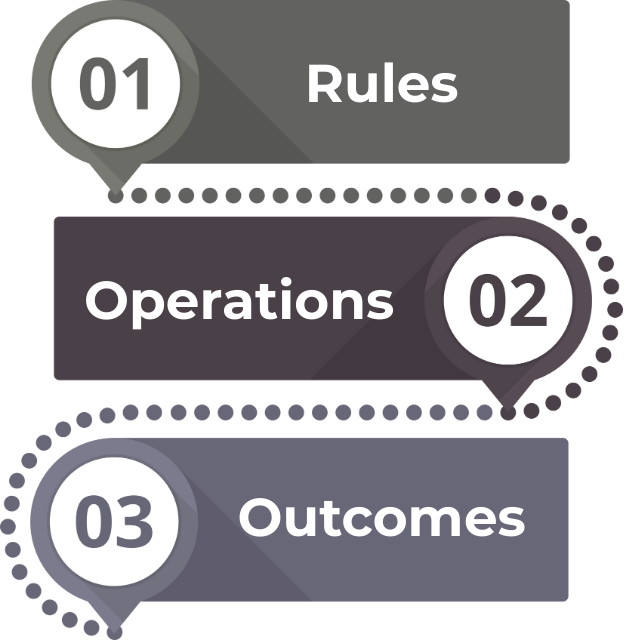
When rules meet reality, operations decide outcomes
On paper, most federally funded programs are logical. Eligibility rules exist for a reason. Documentation standards exist for accountability. Payment processes exist to ensure proper stewardship. Oversight exists to confirm performance.
In practice, staff face decisions every day that are not purely “on paper.” They must interpret requirements under time pressure and handle incomplete documentation. They also have to reconcile conflicting inputs from partners and manage volume without drifting from standards.
That is why operations determine outcomes. When the operational layer is weak, the same symptoms appear across the organization. Backlogs grow, and timelines slip. Two staff members interpret the same requirement differently. Files do not support the decision. Findings repeat across review cycles. Complaints increase because answers feel inconsistent.
None of those problems comes from a lack of rules. They arise from the gap between rules and day-to-day execution. That gap is where program risk lives.
Strong delivery closes that gap. It turns standards into consistent decisions. It also turns oversight into confirmation, not surprise. In addition, it reduces stress for everyone involved. Residents feel the difference first. Partners feel it soon after. Oversight bodies see it during monitoring.
This is the core lesson from PBCA work. Programs succeed or fail in operations. The “how” matters as much as the “what.” Agencies that treat operations as strategy perform better over time.
Program integrity operations need usable rules
Program integrity operations require more than distributing guidance. Guidance has to become usable. It has to be understood the same way across teams. It also has to show up in daily actions.
When rules change, programs often push updates through email. That is necessary, but it is not sufficient. Email rarely creates consistency by itself. Staff still need a shared understanding. They also need clarity on what changed and why it matters.
Operational clarity is about creating alignment. A program should be able to answer basic questions without confusion.
- What is required for a defensible decision?
- What documentation supports it?
- What is the standard for completeness?
- Where do staff escalate uncertainty?
PBCA work reinforces how quickly ambiguity becomes risk. In a high-volume environment, small interpretation differences scale fast. One unclear requirement can generate hundreds of inconsistent outcomes. Over time, that becomes repeat findings and rework.
Clear rules also need a way to stay consistent over time. That is where quality control embedded in the workflow matters. It helps programs catch drift early, reduce repeat errors, and strengthen defensibility before issues become expensive corrections.
Edge cases matter here. Every rules-driven program has routine cases and complex cases. Complex cases are where drift begins. They are also where findings tend to cluster. A strong program anticipates those situations. It clarifies expectations before confusion spreads.
This is also where resident-facing signals matter. If residents and partners ask the same question repeatedly, the rule may be clear on paper. Yet the operational explanation may be unclear. That is an integrity issue, not a customer service issue.
Federal internal control frameworks reinforce this idea. Internal controls depend on clear information and consistent execution. GAO’s Green Book is a valuable reference for internal control expectations in government programs.
For many federal assistance and grants programs, Uniform Guidance also matters. It emphasizes internal controls and accountability across federal awards.
The takeaway is simple. Rules must be operationalized in a way staff can apply consistently. Otherwise, oversight becomes correction instead of validation.
Program integrity operations travel across federal portfolios
Program integrity operations are not unique to housing. PBCA is simply a demanding environment that makes the stakes visible. Oversight is frequent. Documentation requirements are fundamental. Stakeholder expectations are high. Therefore, the operational lessons become clear quickly.
Those lessons transfer to many federal contexts. They apply to:
- Benefits programs that manage eligibility and recertifications.
- Grant programs that manage subrecipients and reimbursements
- Inspection and field service programs that verify conditions
- Complaint intake programs that must respond consistently
- Disaster recovery programs with heavy documentation pressure
Across these environments, the same truth holds. When operational standards are clear, outcomes improve. Decisions become faster and more consistent. Files become easier to defend. Rework declines because fewer errors repeat. Staff capacity increases because time is not lost to avoidable corrections. Stakeholder trust improves when answers are perceived as reliable.
When operational standards are unclear, the opposite happens. Programs rely on informal workarounds. Knowledge becomes tribal and uneven. Oversight teams spend time reconstructing decisions. Leaders get surprised by repeat findings. Public confidence erodes because the experience feels unpredictable.
This is where diversified federal portfolios benefit from PBCA-tested thinking. PBCA taught us how quickly delivery systems can drift. It also taught us the value of structured feedback loops. In many programs, the first signal of drift is not a finding. It is a pattern in questions, complaints, or errors.
That is why resident and constituent experience belongs in program integrity conversations. Experience reveals where policy and practice diverge. That divergence is where risk grows.
For housing context and the PBCA environment, HUD’s Multifamily resources provide background on program structures.
Questions agencies and primes can use right now
Leaders do not need a vendor’s internal playbook to evaluate operational strength. They need the right questions. These questions apply in housing and beyond.
Do staff have a shared, usable interpretation of key requirements? Are similar cases handled consistently across teams and locations? Where do backlogs form, and what causes them? What types of decisions generate the most rework? How does the program learn from repeat issues? When guidance changes, how quickly does behavior change?
Also, ask a resident and constituent question.
- Where do people get confused most often?
- What questions repeat month after month?
- What concerns reappear in the same places?
- What issues escalated due to the early response being unclear?
If these answers are hard to produce, the program likely has an operational gap. That gap is not a failure of intent. It is a design issue. It can be improved.
How Navigate supports program integrity and operations
Navigate’s PBCA experience strengthened our approach to delivery in rules-driven programs. We have spent years translating complex guidance into reliable operations that protect people and public funds.
We support agencies and primes that need stronger program integrity in diverse federal environments. That can include:
- Operational design and performance management
- Compliance support and monitoring alignment
- Resident- and beneficiary-support functions
- Training and change management that improves consistency.
If you want to explore how PBCA-tested lessons apply to your broader federal portfolio, we are happy to talk. Email our Partnership Team at partnering@navigatehousing.com.