The PBCA Contact Center Is Core Compliance Infrastructure
Contact center compliance turns public inquiries into early risk signals. It strengthens documentation, trust, and audit readiness.

In federal programs, contact center compliance is often misunderstood. Many teams treat contact centers as a customer service function. That view is incomplete. In practice, contact operations can function as governance infrastructure. They shape what gets documented. They also shape what leaders learn. Our PBCA experience made this lesson unavoidable.
Within our PBCA work, our Resident Concerns team serves as a dedicated front door for resident issues and follow-through. People do not experience programs through policy manuals. They experience programs through outcomes and interactions. Therefore, the “front door” matters. When that front door is structured, programs become safer.
We believe this to be true across federal portfolios.
A contact center is where confusion surfaces first. It is also where risk signals appear early. If the contact function is weak, signals scatter. They land in inboxes and voicemail boxes. They also land in social media threads. Then, leaders lose visibility.
However, when contact operations are designed for integrity, signals become usable. Concerns become traceable. Trends become visible. Decisions become more defensible. As a result, programs can respond earlier.
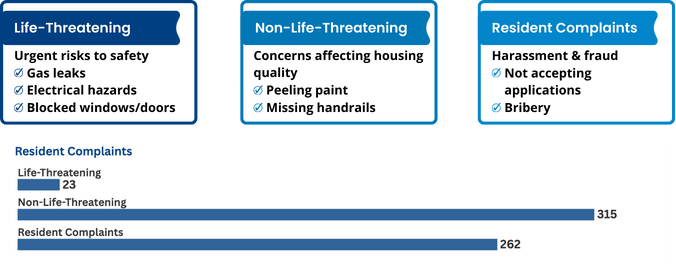
A look at the number and types of Resident Concerns documented by Navigate in 2024
This snapshot shows why contact operations are more than a service function. The mix and volume of concerns create a real-time view of where communication, conditions, or compliance may be breaking down. When programs can see those signals early, they can respond sooner, document decisions more clearly, and reduce preventable escalation.
Why contact center compliance matters
Contact center compliance matters because federal programs are rule-driven. They are also high-volume. They rely on documentation and consistency. Yet people bring real life into those rules. That is where friction begins.
A structured contact function reduces that friction. First, it creates a reliable intake path. People know where to go. Staff know what to do next. That reduces chaos and delay.
Second, it supports consistent documentation. Consistency protects residents and beneficiaries. It also protects program partners. It gives oversight teams a clearer trail. That trail matters during monitoring and audits.
Third, it strengthens follow-through. A program can acknowledge concerns consistently. It can also route concerns responsibly. Most importantly, it can track whether a response happened. That protects credibility over time.
Finally, contact operations can reduce preventable costs. Rework is expensive. Late corrections are disruptive. Early signals help programs correct course sooner. That protects staff time and partner capacity.
This is not just a housing issue. It is a federal program issue. Any program with oversight pressure needs reliable information flow. Otherwise, leaders learn about problems too late. They learn through findings or headlines.
Contact operations also influence trust. People judge fairness through responsiveness. They judge competence through clarity. Therefore, a contact center shapes public confidence. That confidence affects escalations and complaints.
Contact center compliance creates early warning signals
A well-run contact function does more than answer questions. It creates early warning signals for program integrity. Those signals can reveal patterns. They can also reveal communication gaps. Additionally, they can reveal breakdowns in field execution.
How patterns emerge before formal oversight
Patterns rarely start in audit reports. They often begin in everyday contacts. People report repeated confusion. They ask the same questions again. They raise similar concerns about the same locations. Over time, those themes become risk indicators.
When leaders can see patterns, they can act. They can clarify guidance. They can adjust communications. They can also strengthen oversight focus. That is how minor issues avoid becoming systemic failures.
Early signals also improve audit readiness. Audits focus on evidence and consistency. Therefore, documentation quality matters every day. A structured contact function supports that quality. It creates a record that is easier to defend.
This approach also supports access. Many households rely on clear pathways. They may not know agency structures. They may not have time to navigate complexity. A single, consistent contact path reduces barriers.
It also supports partner performance. Owners, vendors, and subrecipients need consistent answers. They also need predictable channels for problem-solving. When guidance is inconsistent, compliance risk grows. When channels are scattered, accountability weakens.
However, early warning only works with leadership attention. Contact insights must reach decision makers. They must also connect to program oversight. Otherwise, the contact center becomes a warehouse of stories. That is not enough.
Therefore, the key is integration. Contact insight should inform training and communications. It should also inform risk conversations. It can even inform monitoring priorities. The exact model will vary by agency.
We keep our internal methods proprietary for a reason. Yet the principle is public and proven. Structured communication strengthens internal control. It improves information flow and accountability.
For general context on federal internal control principles, GAO’s Green Book is a useful reference. It highlights the role of information and monitoring in strong control environments.
Transferable strengths for federal programs
PBCA is a demanding environment. Oversight is real and frequent. Stakeholders are diverse. Documentation matters constantly. Therefore, PBCA forces operational discipline.
That discipline transfers well. It applies to benefits administration. It applies to grants management. It applies to complaint intake and casework. It also applies to inspection and field service programs.
Many federal programs face similar pressure points. They manage eligibility or compliance rules. They depend on vendors or partners. They face audits, monitoring, or IG attention. They also face public scrutiny.
Why contact operations become strategic
In that context, contact operations become strategic. They provide a structured way to hear the field. They also offer a structured way to listen to the public. That reduces blind spots.
Here are high-level design principles that travel well. They are governance expectations.
- First, define the contact function as part of the program infrastructure. Do not treat it as an add-on. Align it with program leadership priorities. Resource it accordingly.
- Second, set documentation standards that support defensibility. Focus on clarity and traceability. Avoid reliance on informal memory. Ensure records support consistent decision-making.
- Third, establish clear accountability for follow-through. Make ownership visible. Ensure urgent issues move appropriately. Ensure routine issues close reliably.
- Fourth, connect contact insight to learning. Use trends to improve guidance and training. Use trends to improve partner communication. Use trends to enhance program messaging.
- Fifth, use contact insight as a risk lens. Combine it with other performance signals. That might include monitoring results. It might consist of inspection trends. It might include payment anomalies. The combination strengthens decision quality.
When these principles are present, contact data becomes useful. It becomes more than anecdotes. It becomes operational intelligence. That is how programs move from reactive to preventive.
For grants and many federal assistance programs, Uniform Guidance is also relevant. It emphasizes internal controls, documentation, and accountability expectations across federal awards.
How Navigate supports program integrity
Navigate’s mission is centered on access, safety, and fairness. That requires strong operations. It also requires strong integrity systems. PBCA work sharpened those capabilities.
We support agencies and primes who want stronger program performance. We help translate frontline signals into leadership visibility. We also help strengthen documentation quality and consistency. Importantly, we do this without exposing proprietary internal playbooks.
Our support can include strategic-level contact function design. It can also include governance alignment across teams. In addition, it can consist of training and communication improvements. The goal is fewer surprises and stronger defensibility.
We also bring a constituent-centered lens. Programs serve people, not processes. Therefore, experience and compliance must work together. When they do, programs gain trust and stability.
If your federal program manages inquiries, concerns, or complaints at scale, this strength applies. If you manage vendors or subrecipients, this strength applies. If you face audits and monitoring, this strength applies. A structured contact function can reduce risk and improve accountability.
If you want to explore how these integrity strengths apply to your portfolio, please contact our Partnership Team at partnering@navigatehousing.com.