SEARCH DATA SIGNALS HOUSING NEED
Affordable housing analytics show rising demand for rent help, housing clarity, and property search information.

Affordable housing analytics can reveal more than website performance. They can show what people are trying to solve. They can also show where pressure in the housing market is shaping search behavior. When users are drawn to pages about rent responsibility, subsidy coverage, and local housing options, that pattern deserves attention.
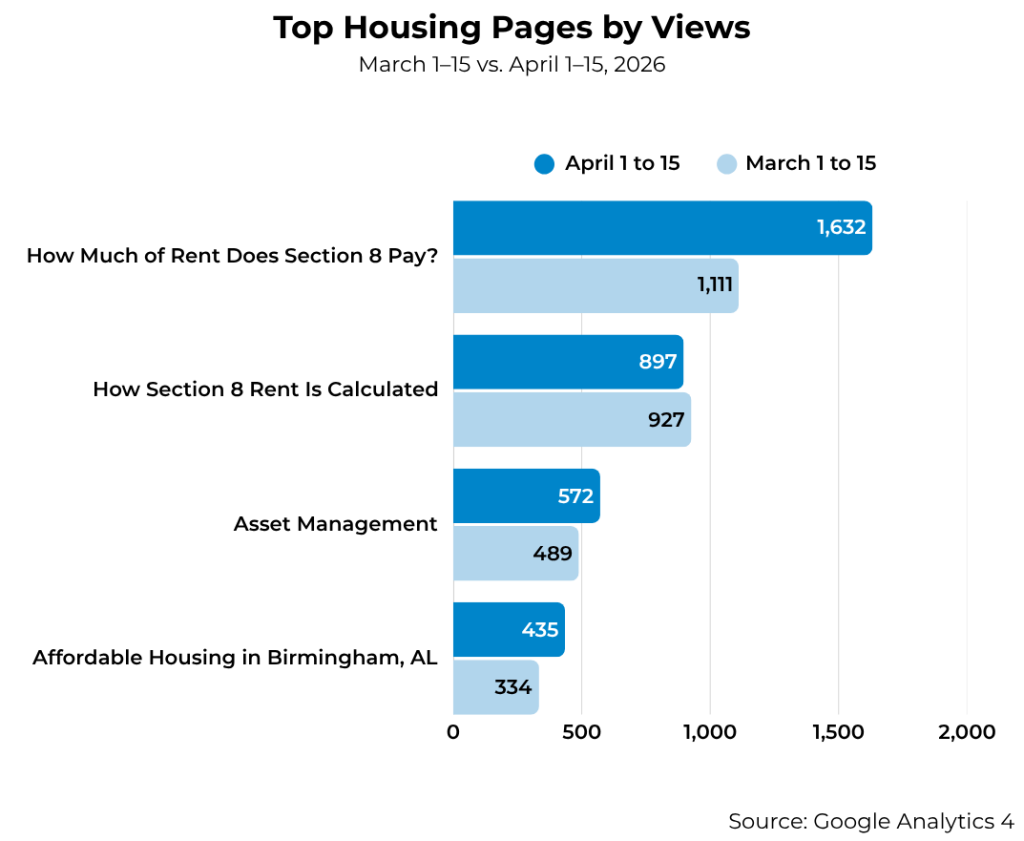
That is the clearest takeaway from Navigate’s recent performance comparisons. In the January through March 2026 data, the top-performing pages were not broad brand pages. They were practical pages focused on housing costs, rent responsibilities, and affordable housing options. The strongest page was “How Much of Rent Does Section 8 Pay?” with 7,202 views. A blog titled “How Section 8 Rent Is Calculated” and the page Affordable Housing in Birmingham, AL received 5,198 and 2,262 views, respectively. Our Asset Management page drew 3,154 views.
Those rankings matter because they reflect user intent. People are not only browsing for general information. They are looking for answers that affect their budgets, their housing options, and their next steps.
Key Takeaways
Search interest is clustering around questions about rent, subsidies, and affordability.
That points to a real need and a stronger demand for clarity.
Owners and agents should connect information to action more clearly.
That reading also fits the broader housing picture. The National Low Income Housing Coalition reported in March 2026 that the United States faces a shortage of 7.2 million affordable and available rental homes for extremely low-income renters. The group also found that only 35 affordable and available homes exist for every 100 extremely low-income renter households. HUD likewise continues to track severe unmet rental need through its Worst Case Housing Needs reports, which measure very low-income renters who lack assistance and pay more than half their income for rent, live in severely inadequate housing, or both.
What the top pages suggest about housing pressure
The strongest message in the data is that users want practical housing information. They want to know what the rent may cost them. They want to understand how assistance works. They want to explore local affordable housing options.
That makes the top pages especially telling.
“How Much of Rent Does Section 8 Pay?” and “How Section 8 Rent Is Calculated” both perform well because they answer immediate questions. These are not abstract policy topics. They are decision questions. A user searching these topics is often trying to understand what they may owe and whether housing is within reach.
The Affordable Housing in Birmingham, AL page adds an important local layer. It shows that users are not only asking general affordability questions. They are also looking for place-based answers tied to a real market.
The Asset Management page deserves careful interpretation, too. In this case, it is not simply a corporate information page. It is the place where users can find and apply to properties owned by Navigate. That means its strong performance likely reflects direct housing-seeker behavior. Users are not just reading about services. They are looking for housing opportunities and taking action.
Taken together, these pages suggest that the audience is looking for clarity under pressure. The analytics do not, by themselves, prove the cause of that pressure. Still, the pattern is consistent with affordability stress, tight household budgets, and a need for more understandable housing communication.
Affordable housing analytics reveal a communication gap
Affordable housing analytics also point to something the industry should take seriously. Many households still need plain-English explanations of how housing systems work.
If pages about rent calculations and subsidy coverage are drawing strong interest, that means many users are not getting those answers clearly elsewhere. In that sense, this is not only a traffic story. It is a communication story.
Too often, housing organizations write as if the audience already understands the system. They rely on terms that make sense internally but create friction for the public. They explain programs in technical language. They separate information from action. The result is that users continue to search for basic answers.
This is where communication becomes operational. Clear content can reduce confusion. It can build trust. It can help a user move from uncertainty to action. For housing organizations, that matters because the questions people ask are often tied directly to leasing, eligibility, and decision-making.
That raises an important question for owners and agents. Are they marketing to the right people in the right way?
The answer may be that they are reaching the right audience, but not always with the right message. In this environment, users may not be looking for polished marketing first. They may be looking for reassurance, transparency, and understandable information about what housing may actually cost.
Affordable housing analytics should shape owner and agent response
Affordable housing analytics should not stay trapped in a dashboard. They should influence how owners and agents communicate.
First, explanations of rent should be easier to find. Users should not have to dig for basic information about affordability, subsidy calculations, or next steps. Second, content should be written in language that reflects real questions, not just internal terminology. Third, informational pages should connect clearly to action. A user who learns how rent works should be able to move directly to property information, availability, or contact options.
This is one reason the Asset Management page matters so much. Because it allows users to find and apply to Navigate-owned properties, it connects information to opportunity. That makes it more than a branding page. It is part of the real housing search journey.
Owners and agents should also ask whether their websites overemphasize what they want to say rather than what users need to know. If search demand clusters around affordability and rent questions, then the market is telling them where clarity is most needed.
Affordable housing analytics and visibility with public-sector partners
Affordable housing analytics can also support a broader visibility strategy with state and local governments. Not as a hard sell, but as evidence of relevance.
When a housing organization attracts attention to practical housing questions, it shows that public needs are being met with organizational clarity. That matters in community development, grant administration, and public-sector work. It suggests the organization understands not only housing systems, but also the questions residents actually bring to those systems.
That kind of visibility has strategic value. State and local governments need partners that can help connect policy, operations, and public understanding. Urban Institute has noted that states are playing a larger role in addressing housing affordability because housing challenges are deeply local and not always solvable by local governments alone. In that environment, organizations that can translate complexity into usable information bring real value.
The larger point is simple. Search data is not just about clicks. It is about demand. In this case, the demand is for understandable housing information tied to rent, affordability, and access. That is useful for owners and agents. It is also useful for public partners seeking organizations that understand how housing needs manifest in the real world.
Search data does not tell the whole housing story, but it does show where people are looking for help and where clearer communication can better meet real housing need.